Tuesday, 25 September 2012

Monetary policy: Is the Central Bank more ‘hawkish’ than warranted?


In its latest Mid-Quarter Monetary Policy Review (September 2012), the RBI has slashed CRR of the net demand and time liabilities (NDTL) by 25 basis points from 4.75 % to 4.50 % . But it left untouched repo rate (at 8.0%), reverse repo rate (7%), and the marginal standing facility (MSF) rate and the Bank Rate at 9.0 %. The industry, amidst a severe slowdown was expecting rate cuts. But they were bit disappointed. The RBI in its press release said that this reduction of CRR would infuse Rs 17,000 crore into banking system. While it lauded government’s commitment to reduce fiscal deficit, it said, however, that that elevated inflation rate and core inflation are beyond comfortable level, preventing any rate cuts.
Is the RBI more ‘hawkish’ than expected to be? It seems to be. Remember that ‘policy rate’ has been on elevated level since March, 2010. Despite this, the inflation has not been tamed to RBI’s comfort level that is 5-6%. The economy is still in ‘doldrums’. And the industrial sector is on a free-fall! Given the fact that the government has shown serious commitment to reduce fiscal deficit and the inflation remains sticky despite a tight monetary policy, it would have been probably better to infuse much needed capital to the bleeding industrial sector. The RBI has always maintained its pro-poor stand. While being ‘hawkish’ is good, going too far in the pursuit of “successful chaser” would do more damage than good to the country. It seems that the RBI is chasing a distant dream.
The RBI Deputy Governer Subir Gokarn has admitted that its elevated policy rates contribute to one-third of the slowdown of the Indian economy. What happens to unemployment rate? Firms being liquidity constraint both in the domestic and foreign market, is expecting the RBI to deliver. This curtails their investment plans.
High interest rates may be counter-productive to the very objectives RBI is pursuing for. First, growth of loans to the agricultural sector will decline considerably. Further, if it succeeds reducing credit supply to industry in the face of agricultural stagnation, it may push India into a stagflationary situation. Second, the rise in the interest rate leads to increased cost of production in the industries. Industry, following a mark-up rule, shall pass rise in cost to consumers and this will only accelerate the inflation. Finally, we may land in a high inflation rate if the RBI in pursuit of curbing inflation maintains status quo of key policy rates in the face a bad cropping session.
Given the free-fall of the industrial sector and the impact of rise in diesel price, still it could have been better if the reserve bank could have cut its key policy rates. Although employment generation in the organized industrial sector is very less, yet the economic slowdown warrants a rate cut. Pushing too far will not ultimately serve anybody’s interest.

The Reform Train finally saw the Green light!


So, Prime Minister Manmohan Singh finally signaled the ‘green light’ to the reforms train. What made him to go after the so-called ‘big bang reforms’? Did he respond to the most scathing attack by a Washington Post columnist  Simon Denyer (referring him as a ‘tragic’ figure) or the economy continuously going down and down to such an extent that it warranted threating to downgrade India’s rating status by the dubious global rating agencies and Planning Commission’s reduced economic growth forecast to 8.2% for the 12th five-year plan. Well, my haunch is that he responded more to the sharp comments made by Simon Denyer than the economy moving to the ‘twilight zone’. After all it is learnt that Prime Minister said in a cabinet meeting that “if we have to go down, we have to go down fighting”. Expectedly this brings cheers to “deficit hawks”!
Well, will the incremental reforms see the light of the day? It depends. It depends upon a combination of factors: the commitment of the respective ministers to get it implemented, administrative reforms and writing down the rule of law very clearly and so on. It is a well-known fact that growth economists around the world want the countries to have a good legal framework that would play a crucial role in wooing investment. Writing down clear “rule of law” would protect the investors’ interest, their property rights that allow investors to appropriate their fair share. Now we shall discuss the reforms one by one.

Diesel prices

The diesel price has been increased by Rs 5 per liter. And the number of LPG cylinders that a consumer can access in a year has been slashed from 17 to 6. Does it merit increasing the price? No. Well, the advocates of reform camp would argue that it was a much needed step to rescue the bleeding oil marketing companies (OMC) and reigning in the cancerous growth of the fiscal deficit.  But if I were to argue my line of reasoning would be different from the prevalent understanding. A high oil price has these following merits. First, investments on alternative energy sources would rise. Global warming is one of the biggest challenges the world is facing today. We know that temperature is going up and up. Transport sector is a significant contributor to the global warming  via CO2 emission. Hence, it merits allowing price to rise. It is a sort of carbon tax or Pigouvian Tax.  It would lead investment on alternative energy sources. In 2007, Phill Izzo has to say this. 

The government should encourage development of alternatives to fossil fuels, economists said in a WSJ.com survey. But most say the best way to do that isn't in President Bush's energy proposals: a new tax on fossil fuels. (See Wall Street Journal: Is It time for a New Tax on Energy?, 2007).  

Similarly, Harvard economist Greg Mankiw also advocated for Pigovian taxes, for it has tremendous merits. In this way, it may lead towards achieving ‘energy independence’. Second, we know that traffic problem has emerged as a biggest obstacle to cities in India. It would force commuters to use the mass rapid transit system. Third, it would accrue to benefit to India. We know that we import around 80% of oil.  This puts a heavy burden on the current account. Having said this, it must not be taken granted that India should shoulder all the responsibility in reducing carbon emissions from the world. Well, all sound good! But the million dollar question is does India need this price hike?

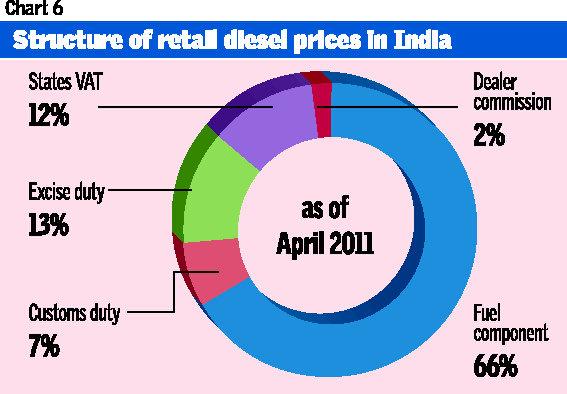
But the notion of ‘loss’ is highly questionable. Economists C. P. Chandrasekhar and Jayati Ghosh in a Macroscan column rightly questioned the rationale of India imposing 43% of tax in petrol price (and 32% for diesel). See the below charts (which are taken from Macroscan). In fact, this is a fake subsidy that the Singh government is vigorously pursuing to reduce it.

The last Chart, in fact, shows that the fuel tax collection outnumber the fuel tax subsidies. See Surya Sethi’s article published in the Economic and Political Weekly where he analyzed in detail recommendations of The Parikh Committee on pricing of petroleum products and expose the fallacy of subsidy. When developed countries like the US, Canada, Japan have low tax rates on gasoline products, what explains such a high tax rate in India? Then why this madness?

Similarly, the government also announced that it would reduce number of subsidized LPG cylinders a household can avail in a year. Though data on various taxes imposed on LPG is not available, I believe it is the same case for LPG cylinders. On the whole my argument is that government should not have hiked the prices. The current price already has taken care of Pigovian taxes.


FDI in Retail
To revive the market ‘sentiment’ or ‘confidence’ of investors, it has also opened up its $500 billion retail market and aviation sector to foreign participants. Notwithstanding the opposition’s opposition it merits to allow FDI. Note that the same BJP has even permitted 100% in retail in 2001 (see the OP-ED on the Indian Express published on 22nd September, 2012). Surely, it would bring modern technology, management that would help save one-third of our produce getting rotten. Also it will help reduce food inflation. consumers would benefit. Farmers too. Remember in 1991 we too debated. That time, off course, was different. We didn’t have experience of the benefits of reform. Hence, at that time our apprehensions deserved merit. But does it merit even now, after seeing and enjoying the benefits of those reforms for 20 years? If yes, then what have we learned? Remember foreign retailers would be allowed only to cities having population one million. We did not we make noise when domestic organized retailers come to exist. How many small shops have been eliminated after the arrival of Big Bazar, Reliance Fresh, and Shopper’s Stop? Then why now? Is it because it is foreign capital?

Well, we are told that a crisis-hit economy requires foreign capital. It has to be evaluated with respect to these four factors: ‘net’ employment, food price, supply management and value chain, and volume of foreign capital. A NCAER study finds out that it is a win-win situation for all the concerned stakeholders. But nobody has said how much capital it would bring to India. I think we should do it as a case study like this. First, count the current retail employment in Delhi. Then after 4-5 years of organized retail, we should again see the retain employment. Then we can say what happens to ‘net’ employment.

One point I want to discuss here with respect to its impact on employment. I want to invoke here David Laibson’s “pull of instant gratification” theory to argue that it may lead to create employment. This is one of the theories of consumption function. In a nutshell this theory says humans like to have what they want right now, not later. They are impatient. It means people have self-control problems. Pulled by psychology we do things instantly to satisfy our pleasure or happiness in a way that we ourselves don’t appreciate in the long run. In plain English, we consume more than what we initially planned to consume and beyond our requirement.  Off course, implicit assumption of this theory is that consumers have access to money. To give an example, we plan to purchase one or two things and fix our budget, say Rs 500. And we plan to buy it from a departmental store or supermarket. But when we reach there and see so many things in front of our eyes, we lose self-control and forget that we fixed our budget to Rs 500. Especially, when we see the “discounts”, “offers”, our ‘instant gratification’ psychology compels us to purchase that thing. In the end, we end up purchasing a lot of stuffs and budget well going over Rs 1000 or more (well, strictly greater than Rs 500). I personally know some of my friends who kind of request me not to invite them when I go to Big Bazar, for the fear that though they don’t have anything to purchase but they will buy something significantly. If this is true, then my haunch is that it would also create employment. If we purchase more then surely they would produce more and hence, employ more people. Looks convincing?

 Questions, however, do need to be asked. How much capital would come to India? Most importantly, by allowing FDI to retail sectors government thinks that it can solve all our supply side problems like setting up of cold storage, go-downs, and so on. The government perception that it would be messiah is ridiculous. Does it mean that the government washes off its hand of all the responsibilities of supply side management of agricultural produce? But Wal-Mart, Carrefour, Spencer, and Metro would not go to villages to establish cold-storages. How much of our produce would be stored in cold-storages? What percentages of our wastage and rotten produce they can save? I guess we have no answers. Hence, government should not forget its responsibility of creating infrastructure in agricultural produce management.

FDI in Aviation
I think opening up this sector to 49% for the foreign participants serves well for the ailing aviation industry, both private and public. Especially, if Indian Airlines agrees to sell some of its stake to a foreign participant, it would save the taxpayer’s money. See the arguments here, here. It would infuse capital, management technique to the industry. Both passengers, aviation industry will benefit from it.
Do I oppose reforms? No. In fact, this price hike was not warranted.  I welcome reforms that would surely revolutionize in its impact on the performance of that sector. Why don’t you reduce various indirect taxes on oil products? Nobody answers this. Everybody hails this as if it is the biggest reform after independence!

A comment on the Prime Minister’s Speech

I sincerely thank you for explaining the rationale of recent economic policy decisions to the aam admi for whom you seem to be very concerned. In fact, you could have explained it much before. In your speech, as usual, you invoked your patented statement ‘money does not grow on trees’. Surely Not. O.K. Coming to your reason of hiking diesel price you told us that it warranted a Rs 17 per liter hike but your benign government only allowed a rise of Rs 5. You produced some dry figures. You even told us that your government reduced taxes on petrol by Rs. 5 per litre to prevent a rise in petrol prices. Why don’t you do this for diesel? Why did not you tell us the merit of imposing such high taxes on oil products? You did not tell that it is a fake subsidy that your government is trying to reduce. 

You said that SUVs (Sports Utility Vehicles) are the biggest beneficiary of these subsidized diesel price and hence, you want to tax them. Surely, government should not run large fiscal deficits to subsidise them. If this is the objective, this can be achieved in other ways. If you are really concerned, then you should impose tax on SUVs.  Why should everybody be punished for few SUV owners and few diesel car manufacturers? You won’t do that. Because it would hurt the interest of capitalists, for whom you and your party are really concerned. You may say that it would hurt auto industry, employment and so in. How does oil price affect the demand for automobiles (SUVs or luxury cars)? We have to look at the coefficient of own price elasticity and cross-price elasticity of demand. Does anybody have any figures of cross-price elasticity, price elasticity, and income elasticity of automobiles demand? When I searched on google scholars “the determinants of automobile demand in India”, I did not find any article. However, the available world literature suggests income, rather than both price and cross-price elasticity, is a bigger factor in the decision to purchase luxury cars. In the Indian context we have to find out which elasticity is bigger: income or price? If income, surely it merits to tax luxury cars. If this is true, then it would not kill much employment. It is surprising that you even did not talk about investment on alternative energy source. Providing enough support to invest in clean energy would also create new employment opportunities.  


Tuesday, 15 May 2012

Sunday, 6 May 2012

Should the Government Bail-out Air-India?

 
So, finally Government of India (GoI) agreed to bail-out a loss making PSU monster AIR INDIA (AI). Well, they call it financial restructuring. In means a substantial cut in interest on AI loans and improving operational efficiency and implementing the turnaround plan.
And you know how well GoI executes its plans.
Should the GoI bail-out an inefficient national carrier?
Is this the same Government that refused to bail-out a private air company?
Why don’t the same logic is applied to a PSU? And plz don’t say that being a national carrier it is our pride  and all such emotional stuffs!!!!!

You know India is country that needs money in good projects, not to infuse money in a loss-making PSU which is in ICU.

Why should GoI not bail-out is that you know GoI can reduce its fiscal deficit through disinvestment proceeds. First, it can stop infusing public money to bleeding PSU company which majorly caters to  the needs of BABA-NETAs. Secondly, it can sale this company and get some money. Since GoI is putting money to the tune of Rs 30OOO Crores, the disinvestment proceeds will be at least equal to that. It means it can reduce fiscal deficit by Rs 60000 Crores. It is such good chance to correct its fiscal slippage.

And by agreeing to save AI, the GoI has not shown any serious commitment to reduce its fiscal deficit.

Now think of the macro-economic implications of this exercise: A reduced fiscal deficit means higher rating by rating agencies (which implies that country's  macroeconomic situations remain stable or good), second it will less crowd out private investment (remember, liquidity is some what tight, though it has been infused by the recent RBI rate cuts). And importantly, it would help reduce inflation.

After all, I don’t understand why we have to be bail-out AI? Is there any compelling reason?

PS: Chetan Bhagat has a piece on ToI.

PPS: When it comes to saving a loss-making PSU, GoI takes decision less time compared to starting the much needed reforms.


Saturday, 5 May 2012

Misplaced Focus?


The recent announcement by the RBI has surprised the market participants. The RBI chooses to reduce the short-term repo and reverse repo by 50 basis points each. RBI has also duly acknowledged the upcoming upside risk to inflation. That the oil marketing companies demanding for higher prices of petro-products day after the annual monetary policy is announced is a pointer to it. It seems that RBI is more concerned about growth. In fact this is the ‘sacred mantra’ which every policy maker is chanting and mad for.
Recognising its failure to combat inflation and the single minded growth objective has led the RBI to increase the threshold inflation to 6.5% in the medium run. So the earlier tolerable inflation of 4.5% will be a history. While most of the developing countries like Brazil (it embraced inflation targeting in 1999) and South Africa (2000), and Ghana (2007) are chasing inflation, our central bank is ‘macho’ about growth. Note that 6.1% growth rate (third quarter of last fiscal) is not a bad figure at all. But expected inflation of 6.5% is surely a bad music to ears of ‘mango people’. To bail out United States from the protracted recession Harvard Economist Ken Rogoff proposed higher inflation that got supported by his Harvard colleague Greg Mankiw, even from the current Fed Chairman Ben Bernanke, Christina Romer, President Obama’s former Chair-woman and many market monetarists and Nobel laureate Paul Krugman. Despite the severity of recession yet the Fed has not pursued this policy. It clearly demonstrates how much significance they offer to inflation (Note that US inflation rate is even below The Fed’s unofficial target of 2%). 
RBI’s rate cut of this magnitude may be based on five reasons. First, an unexpected bigger cut would provide commercial banks enough incentive to lower its lending rates. Second, the transmission mechanism will be more effective and take less time. Third, the RBI tries to learn from its past mistake. One reason why the increase in policy rates could not help much in reducing inflation in a timely manner is that the ‘baby-step’ or the ‘piece-meal’ approach of the central bank. Hence, it thought that so as to have a bigger impact on the outcome it needs to cut drastically the policy rates. Fourth, by lowering rates, the RBI sent signal to the foreign investors that cost of doing business has lowered. And finally, the RBI wants to infuse more liquidity to the market.
But the very first reason may not be achieved. It is because while higher policy rate motivates the commercial bank to increase the interest rate, this may not be the case when the RBI lowers its key policy rates. The reason is that commercial banks are now vying to attract savers through increased deposit rates. Further, RBI has also increased the flow of the saving deposit rates. Another factor that might pour water in the hopes of the Governor Subbarao is the “uncertainty” factor. Banks are not sure whether there will be any further rate cuts. In that case banks are expected to maintain status quo, limiting the effectiveness in the transmission mechanism unless they are being pressed by the finance ministry.
Rationale
It is not difficult to nail down the motive behind the cut in policy rates. RBI cited in its monetary policy statement that the deceleration in the economic growth is the result of slower industrial growth. Further, RBI should not panic at the falling Index of Industrial Production (IIP) which is highly fluctuating and are far from credible and calls for scrutiny. Again, RBI thinks that liquidity was squeezed as credit demand both from industry and agriculture has not peaked up. This leads to contraction in gross fixed capital formation (GFCF) both in the second and third quarters of last year. In other words, the RBI thinks that money was tight for this period. Though private GFCF are below the trend since 2008-09, but they have rebounded following a drastic fall in 2008-09. Hence, quarterly fluctuations do not warrant such steep cut on the policy rates given that both WPI inflation and CPI inflation are hovering around 7% and 9% respectively. Since the onset of high interest rates, the growth rate of credit to industry remains stable. Agriculture recorded a steep fall in the credit growth from 22.9% in 2009-10 to 10.6% in 2010-11.Two factors contribute to this. First, the impact of high interest rates and second, the non-food credit growth rate has increased from 16.8% from 2009-10 to 20.6% in 2010-11. The behaviour of eight core industries shows that the growth rate is around its trend rate of 5.5%. Though these falling numbers call for a reduction in the policy rates we need to ask as to who contributes more to it: global slowdown, higher interest rates, or supply side problems? It seems that the current understanding of the RBI is that our growth has slowed down because of global slowdown which is not entirely right. Growth has been robust following the sharp decline in 2008-09. Rather, the major contributor to the economic slowdown is the almost zero growth rate of agriculture. Agriculture is still the major determinant of growth and inflation. Agricultural performance feeds through to the rest of the economy through supply and demand linkages. Reduced agricultural growth reduces supply to industry, thereby reducing industrial production. Further, a reduced income from agriculture and the fact that they spend more on the food stuffs also contribute to the contraction in demand for industrial production. Hence, the decline in industrial performance is not that investment is not picking up. Rather, the diagnosis and the solution remain elsewhere.
The best option could have been to let the policy rates remain intact and wait till the next mid-quarter review to see the evolution of both WPI and CPI inflation and how GDP and IIP behave. The RBI’s policy moves will not help much. Instead targeting inflation could help better achieve more economic growth. A 2011 article in the prestigious Journal of Policy Modeling, written by Salem Abo-Zaid and Didem Tuzemen  has shown that the effects of targeting inflation in developing countries are associated with lower and more stable inflation, as well as higher and more stable GDP growth. They also conclude that non-targeting countries would highly benefit from targeting inflation. In the least case will may have higher GDP growth (satisfying needs of the policy makers and of the government) and higher inflation (surely, welfare-reducing to ‘aam aadmi’.  If any central bank, facing a declining industrial production and hence, economic growth and high inflation, they must ask this question before advancing for monetary policy: how much of the benefit a poor man extracts if it increases the growth rate by one percentage point more compared to how much of the benefit a poor man loses if it increases the inflation rate by one percentage point more (or if there is a chance that inflation might increase) or it does not any take any step to reduce inflation from high rate.
 Solution lies elsewhere
While much of the solution lies in the government, it tries to save its image through the rise in GDP. Hence, the government thinks that high interest rate has stifled down the growth rate of GDP. So the pressure from the government cannot be ruled out in easing the key policy rates. By reducing the policy rates, the RBI has put the ball in the government’s court. First, to address its fiscal deficit, it needs to reduce subsidies. If it does, it will increase the petro prices and urea prices. It will be translated in to higher headline inflation. And if it does not, it may result in the crowding out of private investment (examining the crowding out hypothesis for India for the period 1970-71 to 2009-10, Jagadish Prasad Sahu and Sitakanta Panda in a 2012 article in the prestigious Economics Bulletin have empirically shown that government investment crowds out private investment in the long run). Only the 2G/4G auction and embracing the GST can help the government in correcting the fisc. Government must address the supply side issues promptly and boost the agriculture investment and reducing the subsidies which will help in the long run. It must cure policy paralysis, remove the infrastructure constraints; raise the ease of doing business, and lessen the time overruns. It must recognise the limits of the monetary policy which can’t control these factors.
In the pursuit of growth RBI should not heap misery on more than half of the country’s population. We can at best wish for the victory of RBI’s great gambling and optimism.